I received a nice letter from Jamais asking about the references. I didn’t give a history of the world but mentioned some highlights like the following:
Short version – references are at the very end. Note that CGUI refers to the Computer Graphics and User Interfaces Lab run by Steve Feiner, where I’m currently conducting research on augmented reality and visualization related to the environment. More on that as www.cs.columbia.edu/~swhite
Thanks for writing – I’ve just started blogging, mainly for myself, and didn’t quite realize that I’d get any responses. I’d be happy to help you with the references and appreciate your openness and interest. I could give you the long history of mixed and augmented reality but let me start with the references I mentioned. Keep in mind that this is from a more academic point of view but thus far, much of the research has come from academia.
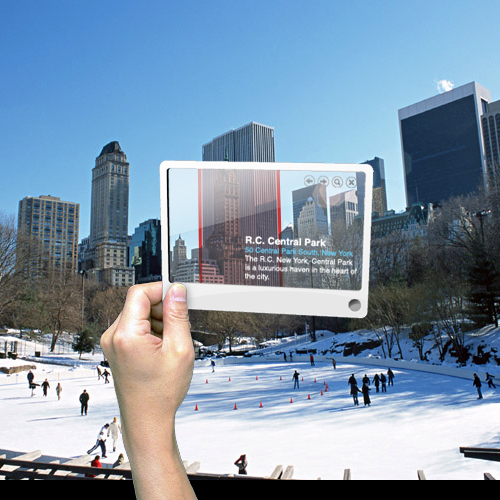
First, there are a lot of terms that get thrown around about how we combine the physical and the virtual to create the real. Milgram and Kishino described a simple continuum of “mixed reality” that moves across virtual environment, augmented virtuality, augmented reality, and the real environment. It’s meaningful because some writers don’t distinguish amongst mixed, virtual, and augmented reality.
Now Steve Mann actually came up with the term”mediated” reality to emphasize that we can change and transform reality, not just mix the virtual and the physical. Thad Starner, having worked with Steve, extended this notion more fully to wearable computing and the idea that you could mediate your reality to, for instance, remove advertising. Then later, Mann actually built a system to experiment with removing advertising – calling it diminished reality. I write about the opposite in my chapter on AR and Mobile Persuasion in BJ Fogg’s edited book – using AR to bring our attention to things that are important.
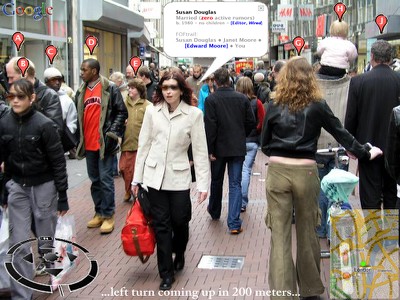
Tobias Hollerer, a CGUI graduate now at UC Santa Barbara, together with several others including Feiner developed interesting early work on filtering mechanisms under the assumption that there’ll be too much data for us to visualize in a scene using AR. He uses a combination of context and location but also explores a social model originally developed by Benford that has a notion of an aura and nimbus for filtering. And he’s not the last to address the issue. It comes up often at ISMAR, the main conference for augmented reality.
If you can’t access any of these, let me know and I’ll get you a copy. And let me know if you have further questions or want a better outline of the evolution of AR and framework for the topics. There are a couple good surveys on the subject as well, mainly by Ron Azuma, but they’re a little out of date.
P. Milgram and F. Kishino, “A Taxonomy of Mixed Reality Visual Displays,” IEICE Trans. Information Systems, vol. E77-D, no. 12, 1994, pp. 1321-1329.
Mann, S. Mediated Reality. Technical Report 260, MIT Media Lab. Perceptual Computing Group. 1995
Starner, T., Mann, S., Rhodes, B., Levine, J., Healey, J., Kirsch, D., Picard, R., and Pentland, A. (1997), “Augmented Reality Through Wearable Computing.” PRESENCE, 6(4), MIT Press.
Mann, S. and Fung, J., “EyeTap Devices for Augmented, Deliberately Diminished, or Otherwise Altered Visual Perception of Rigid Planar Patches of Real-World Scenes,” Presence: Teleoperators & Virtual Environments, vol. 11, pp. 158-175, 2002.
Höllerer, T., Feiner, S., Hallaway, D., Bell, B., Lanzagorta, M., Brown, D., Julier, S., Baillot, Y., and Rosenblum, L., “User interface management techniques for collaborative mobile augmented reality,” Computers & Graphics, vol. 25, pp. 799-810, 2001.